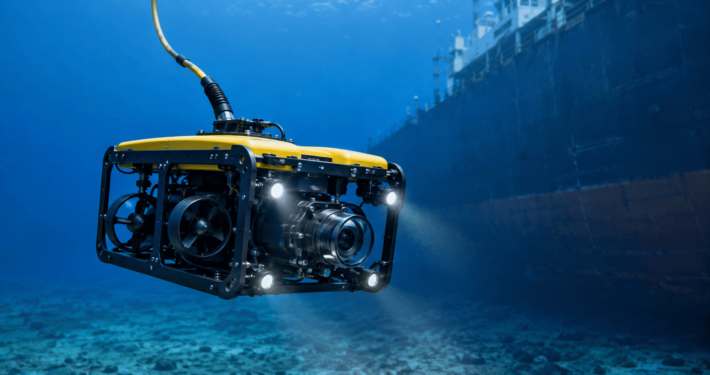
Choosing the wrong ROV for ship hull inspections is a costly mistake. You need a reliable tool, but spec sheets are confusing and don’t guarantee performance where it counts.
The best way to choose an ROV is to match its core components—like thrusters, cameras, and tether—to the specific environmental conditions and inspection goals[^1] of your operations. Stop looking for a single “best” model and start analyzing your specific needs to find the right tool.
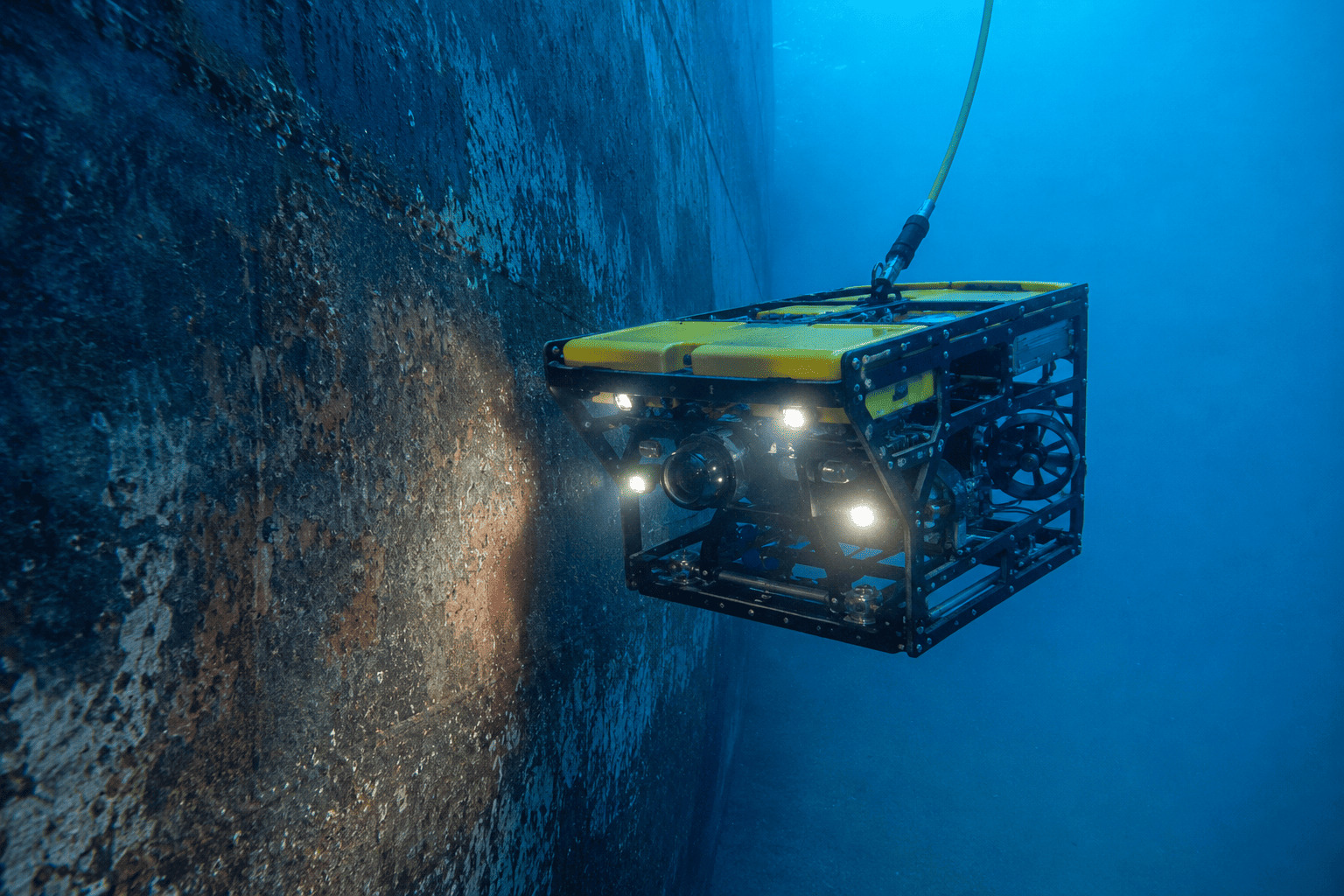
You’ve probably spent hours looking at different ROV models. They all claim to be “inspection-grade,” but what does that actually mean for your day-to-day work? The spec sheets are full of numbers, but those numbers don’t tell you if the ROV will hold its position in a current or if the camera can see through the murky water in your port. As people who manufacture the core parts for these machines, we talk to engineers and procurement managers every day who are trying to solve this puzzle. The key is to stop looking at the ROV as a single product and start looking at it as a system of components designed for a specific job. Let’s break down how to do that.
How Do Core Components Define an ROV’s True Capability?
It’s easy to get lost in marketing terms like “inspection-class.” A high-resolution camera is useless if the ROV can’t get it to the right spot. Focus on the core parts.
An ROV’s capability is the sum of its parts. Its performance depends on how its thrusters provide stability in currents[^2], how its camera and lighting create clear visuals in murky water[^3], and how its tether delivers uninterrupted power and data[^4].
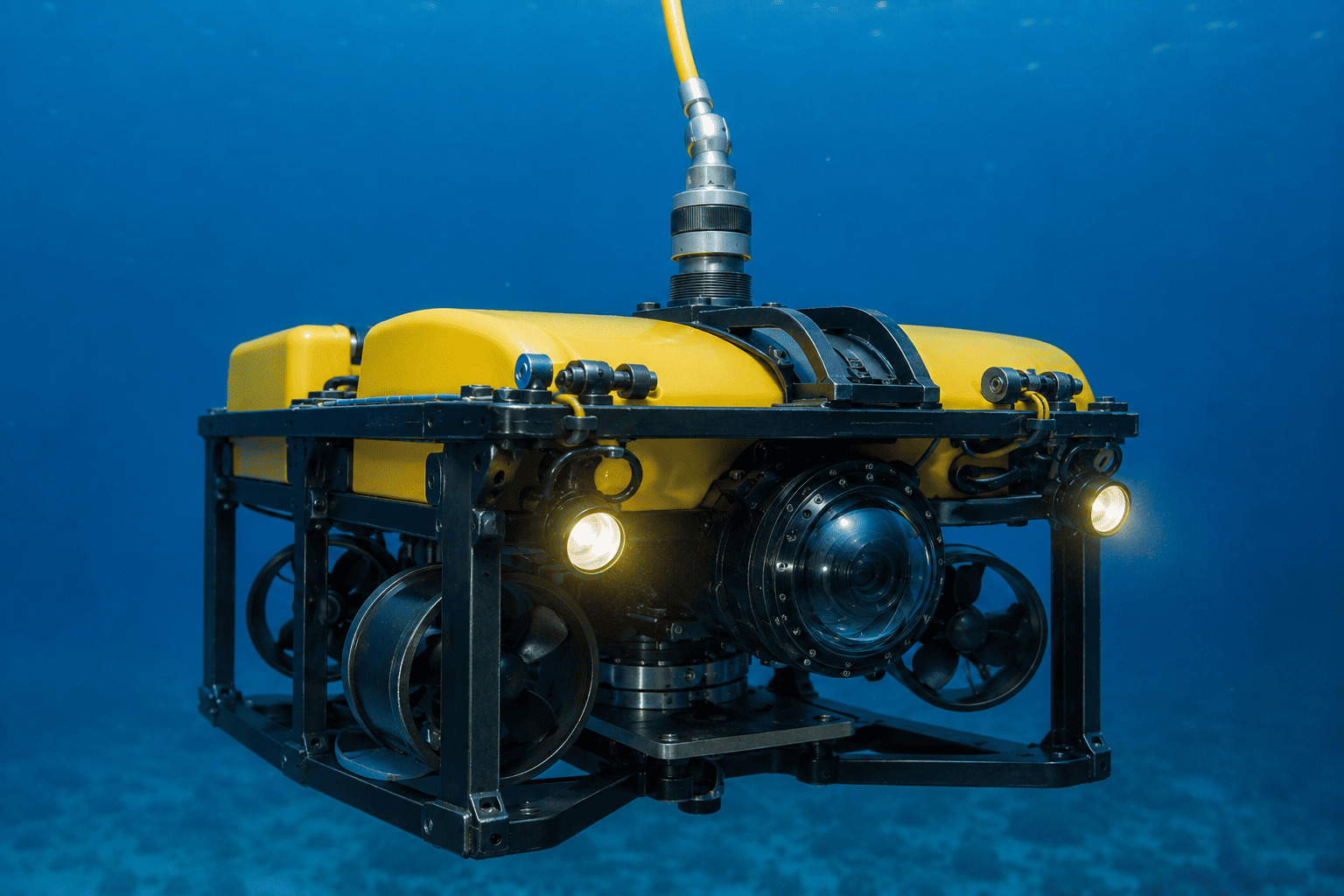
From our perspective as component manufacturers, the term “inspection-grade ROV” is often too broad. We’ve learned from countless conversations with engineers that an ROV’s real-world performance is not a single score. It is a direct result of how its individual components work together as a system. When a client comes to us with a problem, it’s rarely about the ROV as a whole; it’s about a specific part failing to meet a specific challenge. This is why you need to dig deeper than the top-level sales pitch and understand the guts of the machine.
The Components that Dictate Performance
Thinking about components helps you connect a specification to a real-world outcome. Let’s look at the most critical ones for hull inspections.
| Component | What to look for | Why it matters for hull inspections |
|---|---|---|
| Thrusters | Power, configuration (vectored vs. standard), and reliability. | Determines the ROV’s ability to fight currents and hold a stable position for clear video, especially in busy ports or open waters. |
| Imaging System | Camera sensor quality, lens, and especially the power and placement of lights. | A great camera is only as good as its lighting. The system must be able to cut through turbidity and minimize backscatter to find small defects. |
| Tether & Connectors | Diameter, material, durability, and connector reliability. | A thin, durable tether reduces drag in currents[^5], making the ROV easier to fly. Reliable watertight connectors prevent mission failure and costly repairs. |
| Buoyancy Material | Type and quality of foam. | High-quality syntactic foam ensures consistent buoyancy at depth[^6] and over the ROV’s lifetime, which affects stability and payload capacity. |
A failure in one of these “minor” parts, like a connector, can end a mission just as quickly as a failed thruster.[^7] Understanding this helps you evaluate the total cost of ownership, not just the initial purchase price.
How Do You Match an ROV to Your Specific Inspection Scenario?
A general-purpose ROV might look good on paper but could fail at your specific tasks. Imagine your ROV getting swept away by a current during a critical structural damage inspection.
First, define your primary use case. A routine biofouling check in a calm harbor has vastly different requirements than an urgent structural damage assessment in open water[^8]. Analyze your environment and goals before you even look at an ROV spec sheet.
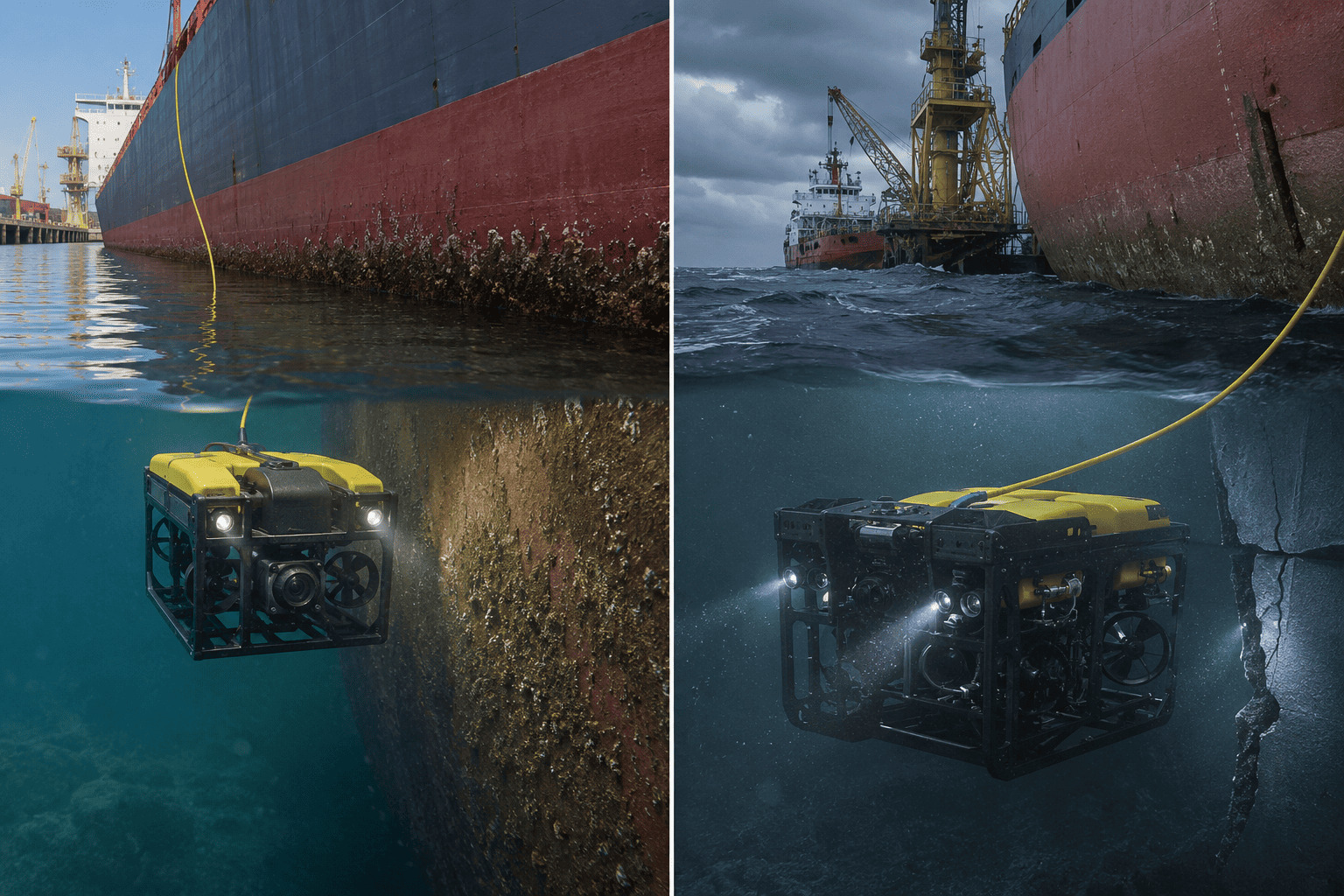
One of the most common challenges we hear from customers is trying to find one ROV that does everything perfectly. That unicorn rarely exists. A more effective approach is to clearly define the 80% of the work your ROV will be doing. This allows you to prioritize the components that matter most for that job. Let’s compare two very different but common ship hull inspection scenarios. This exercise will show you why matching the tool to the job is so important. One scenario demands agility and clear close-up images, while the other demands raw power and advanced sensors. The “best” ROV is completely different for each.
Scenario A: Routine Biofouling Check in a Calm Harbor
In this situation, the goal is to conduct a general visual inspection (GVI) of the hull to assess marine growth, check anodes, and look for obvious coating damage[^9]. The environment is relatively controlled.
- Operational Demands: High maneuverability to navigate around the curved hull and obstacles, excellent close-up imaging in potentially murky water, and ease of deployment.
- Key Component Features:
- Thrusters: A vectored thruster configuration with at least 5-6 thrusters is ideal[^10]. This allows the ROV to move laterally without changing its heading, keeping the camera pointed at the hull. Raw power is less important than precise control.
- Imaging: A good full HD camera is sufficient, but powerful, dimmable, and well-placed lighting is critical to manage backscatter in turbid port water.
- Size: A smaller, more compact ROV is easier to handle and can get into tighter spaces.
Scenario B: Post-Collision Structural Assessment in Open Anchorage
Here, the mission is critical. You need to assess specific structural damage, like a crack or dent, in a less protected environment. The stakes are higher, and so are the environmental forces.
- Operational Demands: Ability to hold a fixed position in moderate to strong currents, high-resolution imaging to identify fine cracks, and potentially the need for a sonar system to see damage in zero visibility[^11].
- Key Component Features:
- Thrusters: You need power. Look for high-torque thrusters that can generate enough force to counteract currents. The ROV’s ability to hold station is your top priority.
- Imaging & Sensors: A 4K camera is valuable for zooming in on digital footage later. More importantly, the ROV must have the payload capacity and interface to carry a sonar system, like a multibeam imaging sonar.
- Tether Management: In currents, tether drag becomes a huge problem. A stronger, thinner tether and potentially a tether management system (TMS) are necessary to prevent the ROV from being pulled off target[^12].
What Are the Right Questions to Ask a Supplier?
Standard spec sheets don’t reveal real-world performance. You might buy an ROV that looks great on paper but fails on the job because the specs were measured in a test tank.
Go beyond basic specifications. Instead of asking “What’s the camera resolution?”, ask “How does the imaging system perform in the low-light, high-turbidity conditions of my port?”. This forces a conversation about real-world capability, not just numbers.
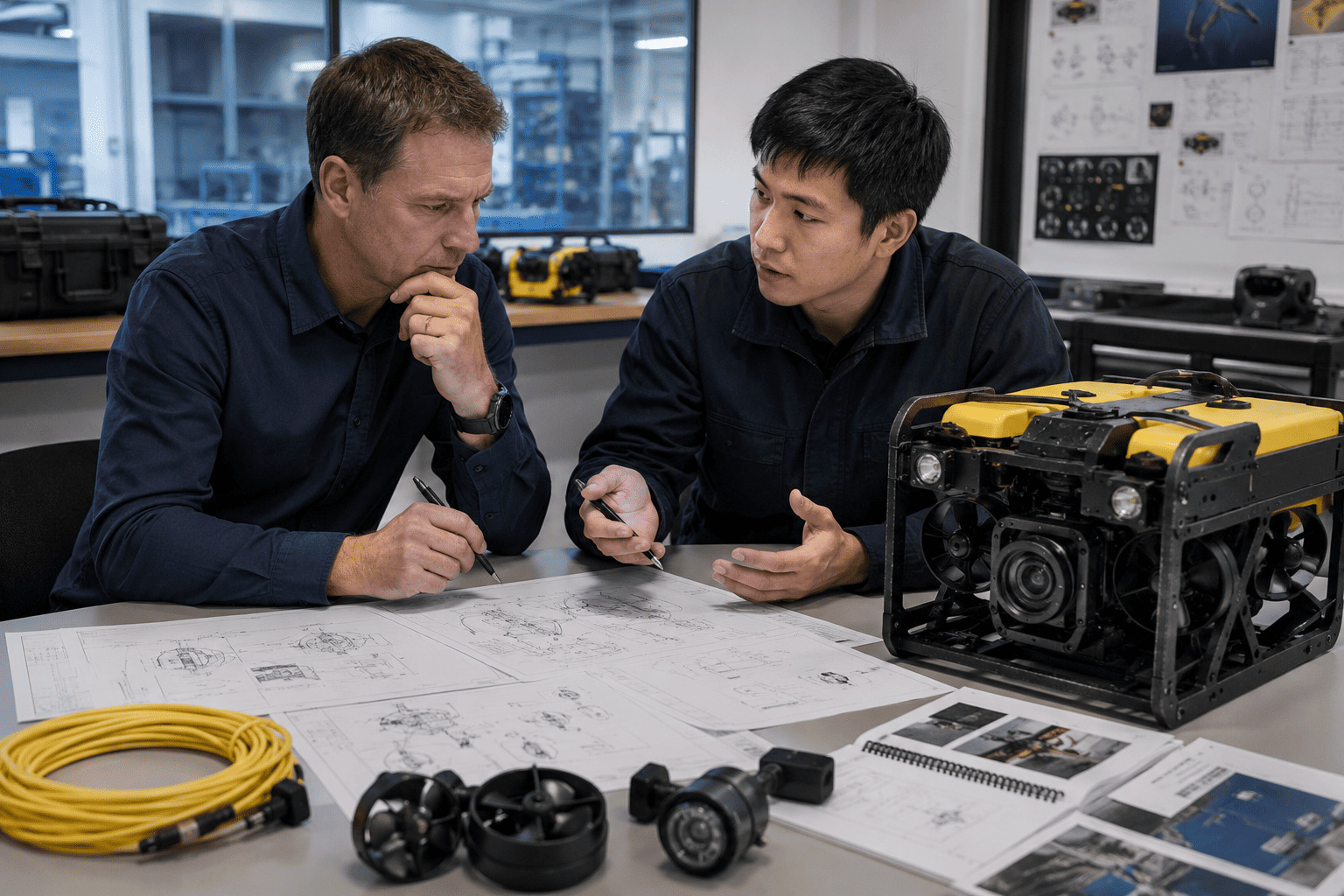
As a parts manufacturer, we help engineers write specifications all the time. The best ones are not lists of numbers; they are descriptions of required capabilities. Your job as a buyer is to translate a supplier’s specifications into a prediction of on-the-job performance. You can do this by asking operational questions, not just technical ones. This pushes the supplier to explain how their system will handle your specific challenges. It moves the conversation from their test lab to your work environment. Here are some examples of how to reframe your questions to get more meaningful answers.
From Technical Specs to Operational Capability
This table shows how to shift your questions to get to the information that truly matters for de-risking your purchase.
| Instead of asking this… | Ask this instead… | Why it matters for your investment |
|---|---|---|
| “What is the thruster’s horsepower?” | “What is the ROV’s tested ability to hold station in a 2-knot cross-current?” | This directly links the thruster power to the primary challenge of working in real-world water conditions. A powerful ROV that can’t hold its position is useless for inspection. |
| “What’s the camera resolution in megapixels?” | “Can you provide sample footage from this imaging system taken in water with 1-meter visibility?” | This tests the entire imaging system (camera, lens, lighting) in conditions that simulate your port. A 4K camera is worthless if the lighting creates a wall of backscatter. |
| “What is the maximum depth rating?” | “What is the material and pressure rating of the watertight connectors, and what is the tether’s abrasion resistance?” | Most hull inspections are shallow, but component failure is a major risk. This question probes the system’s durability and long-term reliability, which directly impacts total cost of ownership. |
| “How long is the tether?” | “What is the tether’s diameter and buoyancy profile, and how does that affect drag in a 2-knot current?” | A thick, floating tether can create so much drag that it overpowers the ROV’s thrusters. This is a common point of failure we hear about from frustrated operators. |
Asking these kinds of questions shows you’ve done your homework. It helps you identify suppliers who understand real-world operations versus those who just sell boxes.
Conclusion
Choosing the right ROV for hull inspections means matching its components to your specific work scenarios. Ask operational questions to understand the machine’s true capability and de-risk your investment.
[^1]: “Tug ROV – MIT”, https://web.mit.edu/12.000/www/m2005/a2/finalwebsite/equipment/robotics/tug.shtml. A marine robotics or underwater-vehicle design source can support that ROV selection is typically driven by mission requirements, operating environment, propulsion, sensing, power, and communications constraints, rather than by a single universal specification. Evidence role: expert_consensus; source type: education. Supports: The best way to choose an ROV is to match core components to the environmental conditions and inspection goals of the operation.. Scope note: This would support the selection framework generally, not prove that it is always the best commercial purchasing method.
[^2]: “Impact of Thruster Dynamics on the Feasibility of ROV Station …”, https://ui.adsabs.harvard.edu/abs/2020ocea.conf…83W/abstract. An underwater robotics source can substantiate that ROV station keeping and maneuverability in currents depend on thruster configuration, available thrust, hydrodynamic drag, and control allocation. Evidence role: mechanism; source type: paper. Supports: ROV thrusters are central to maintaining stability and position in currents.. Scope note: The source may describe ROV dynamics generally rather than ship-hull inspection specifically.
[^3]: “[PDF] Towards improving imaging in scattering media”, https://repository.library.northeastern.edu/files/neu:m044c600q/fulltext.pdf. Research on underwater optical imaging can support that image quality in turbid water depends on illumination geometry, scattering, absorption, camera sensitivity, and the distance between the camera and target. Evidence role: mechanism; source type: paper. Supports: Clear ROV visuals in murky water depend on the combined performance of the camera and lighting system.. Scope note: Such evidence explains the optical mechanism; it may not evaluate any particular ROV camera system.
[^4]: “Launching the ROV – NOAA Ocean Exploration”, https://oceanexplorer.noaa.gov/multimedia/explorations-24pr-usvi-biotech-features-first-expedition-media-working-with-tether/. A technical source on work-class or inspection-class ROV architecture can document that tether or umbilical systems commonly provide power, control, and data communication between the surface and the vehicle. Evidence role: definition; source type: institution. Supports: The tether is a critical subsystem for delivering power and data in many ROV systems.. Scope note: Some small ROVs may use batteries or hybrid architectures, so the citation should be read as describing common tethered ROV practice rather than every ROV design.
[^5]: “[PDF] Development of Tether Mooring Type Underwater Robot”, http://vigir.missouri.edu/~gdesouza/Research/Conference_CDs/IEEE_IROS_2009/papers/1226.pdf. Hydrodynamics literature on marine cables or ROV tethers can support that cable drag in current is related to flow velocity, cable length, orientation, and diameter, making tether diameter a factor in vehicle handling. Evidence role: mechanism; source type: paper. Supports: Thinner tethers can reduce current-induced drag and improve ROV handling.. Scope note: The citation would support the physics of tether drag, not necessarily quantify the drag reduction for a specific product.
[^6]: “Newly developed specification and test methods for syntactic foam …”, https://ui.adsabs.harvard.edu/abs/2010ocea.conf..358W/abstract. Materials engineering sources can support that syntactic foams are used in deep-sea buoyancy because their hollow microsphere structure provides low density and high compressive resistance under hydrostatic pressure. Evidence role: mechanism; source type: paper. Supports: Syntactic foam is used to maintain buoyancy under pressure at depth.. Scope note: The evidence would support the material property generally; long-term buoyancy consistency depends on the specific foam grade, manufacturing, and operating depth.
[^7]: “[PDF] ENS Catalina Kim Le Rico – DSpace@MIT”, https://dspace.mit.edu/bitstream/handle/1721.1/139129/Rico-catrico-ms-meche-2021-thesis.pdf?sequence=1&isAllowed=y. Reliability or subsea-connector literature can support that underwater electrical and optical connectors are mission-critical components because leakage, insulation failure, or signal interruption can disable power or communications. Evidence role: general_support; source type: paper. Supports: Connector failures can cause serious ROV mission disruption comparable to other major subsystem failures.. Scope note: The source may discuss subsea systems broadly rather than documenting failure rates for hull-inspection ROVs specifically.
[^8]: “[PDF] MEPC.1-Circ.918 – Guidance On In-Water Cleaning Of Ships …”, https://wwwcdn.imo.org/localresources/en/OurWork/Environment/Documents/Biofouling%20pages/MEPC.1-Circ.918%20-%20Guidance%20On%20In-Water%20Cleaning%20Of%20Ships’%20Biofouling%20(Secretariat).pdf. Guidance on in-water ship inspection and class or maritime survey practice can support that inspection objectives, environmental exposure, visibility, and defect type influence the equipment and methods used for hull surveys. Evidence role: expert_consensus; source type: institution. Supports: Routine biofouling checks and urgent structural damage assessments impose different ROV requirements.. Scope note: The source may not compare these exact two scenarios but can substantiate that inspection requirements vary by task and environment.
[^9]: “[PDF] UNDERWATER INSPECTION/TESTING/MONITORING OF …”, https://www.bsee.gov/sites/bsee.gov/files/tap-technical-assessment-program//001aa.pdf. Maritime inspection guidance can support that underwater hull surveys commonly include visual assessment of fouling, coating condition, sacrificial anodes, and visible hull damage. Evidence role: definition; source type: institution. Supports: Routine hull visual inspections commonly assess marine growth, anodes, and coating damage.. Scope note: Specific inspection checklists vary by vessel class, owner requirements, and regulatory or classification-society rules.
[^10]: “(PDF) Design and Implementation of a Six-Degrees-of-Freedom …”, https://www.academia.edu/118381824/Design_and_Implementation_of_a_Six_Degrees_of_Freedom_Underwater_Remotely_Operated_Vehicle. Underwater vehicle control literature can support that multi-thruster and vectored configurations increase controllable degrees of freedom, enabling lateral motion and improved maneuverability compared with simpler layouts. Evidence role: mechanism; source type: paper. Supports: Vectored multi-thruster layouts improve maneuverability for close hull inspection.. Scope note: The source can support the maneuverability principle, but the claim that five to six thrusters is “ideal” is application-specific and may require manufacturer testing or operational criteria.
[^11]: “Self Calibration of a Sonar–Vision System for Underwater Vehicles”, https://pmc.ncbi.nlm.nih.gov/articles/PMC9921679/. Marine sonar or underwater inspection sources can support that acoustic imaging sonar is used when optical cameras are limited by poor visibility, because sound propagation can provide images or profiles in turbid water. Evidence role: mechanism; source type: research. Supports: Sonar can support hull-damage assessment when optical visibility is near zero.. Scope note: Sonar can reveal structure and larger defects in low visibility, but its ability to detect fine cracks depends on sonar type, frequency, range, and operator interpretation.
[^12]: “[PDF] Mapping of Underwater Environments with an ROV using a robotic …”, https://www.hmc.edu/lair/publications/2012/boik_Thesis_2012.pdf. ROV operations or offshore engineering sources can support that tether management systems reduce free tether length and help manage cable loads, drag, and entanglement risk during subsea operations. Evidence role: mechanism; source type: institution. Supports: A tether management system can help prevent current-induced tether drag from pulling an ROV off target.. Scope note: Whether a TMS is necessary depends on vehicle size, current speed, tether length, launch method, and inspection geometry.
Leave a Reply
Want to join the discussion?Feel free to contribute!